 | This article needs additional citations for verification. (January 2021) |

A folk dance is a dance that reflects the life of the people of a certain country or region. Not all ethnic dances are folk dances. For example, ritual dances or dances of ritual origin are not considered to be folk dances. Ritual dances are usually called "religious dances" because of their purpose.
The terms "ethnic" and "traditional" are used when it is required to emphasize the cultural roots of the dance. In this sense, nearly all folk dances are ethnic ones. If some dances, such as polka, cross ethnic boundaries and even cross the boundary between "folk" and "ballroom dance", ethnic differences are often considerable enough to mention.[1]
Background
[edit]Folk dances share several commonly recognized characteristics:
- They are typically performed at social gatherings or community events by people with little or no professional training, often accompanied by traditional or folk music.[2]
- Folk dances generally originate as participatory social activities rather than as staged performances, although some may later be adapted or stylized for theatrical presentation.[3]
- Their form and execution are primarily guided by inherited traditions transmitted across generations, reflecting local or regional identities, though gradual adaptation and change are common.[4]
- New dancers typically learn through informal means—by observing, imitating, and receiving assistance from more experienced participants—rather than through formal instruction.[4][3]
Modern social dances such as hip hop and other street styles have often evolved spontaneously within communities, but the term folk dance is generally not applied to them. Instead, they are more commonly referred to as street dances or vernacular dances.[5][6] The term folk dance is typically reserved for dance forms that are significantly bound by tradition and that originated during periods when a clear distinction existed between the dances of the “common folk” and those of the social elite, many of which later evolved into modern ballroom and theatrical dance forms.[7]
Europe
[edit]%2C_by_Alexandre-Thomas_Francia.jpg)
.jpg)


Sword dances include traditional forms such as long sword dances and rapper dancing.[8] Some choreographed social dances, such as contra dance, Scottish highland dance, Scottish country dance, and modern Western square dance, are sometimes described as folk dances, though this usage is not accurate in the strictest ethnological sense.[6][9]
Country dance shares historical and stylistic features with both contemporary folk dance and ballroom dance. Many country and ballroom dances trace their origins to earlier folk traditions, having undergone gradual refinement and formalization over time.[10][7]
Folk dances often developed long before the establishment of modern national or political boundaries, resulting in certain dance forms being shared across multiple countries and cultures. For example, several Serbian, Bulgarian, and Croatian dances exhibit closely related steps, styles, and musical structures, and in some cases even share the same names and melodies.[11][12][13]
International folk dance groups exist in many cities and on college campuses around the world, where participants learn and perform traditional dances from a wide variety of cultures for recreation and social connection.[14][15][6]
Balfolk refers to social dance events featuring live folk-inspired music, popular primarily in Western and Central Europe. The movement originated during the folk revival of the 1970s and has grown in popularity since around 2000. Balfolk events typically include partner dances that were fashionable across Europe in the late 19th century—such as the schottische, polka, mazurka, and waltz—along with a variety of regional and traditional dances, mainly from France, but also from Sweden, Spain, and other European countries.[16][17][6]
Varieties of European folk dances include:
- Austrian folk dance
- Ball de bastons
- Ballet
- Barn dance
- Bulgarian dances
- Circle dance
- Dutch crossing
- English country dance
- Fandango
- Flamenco
- Freilekhs
- Georgian dance
- Greek dances
- Hora
- International folk dance
- Irish dance
- Italian folk dance
- Jenkka
- Jota
- Kolo
- Ländler
- Maypole dance
- Morris dance
- Polka
- Polish folk dances
- Russian folk dance
- Turkish dance
- Ukrainian dance
- Verbuňk
- Nordic polska dance
- Schuhplattler
- Square dance
- Sword dance
- Weapon dance
- Welsh dance
- Zwiefacher
Middle East, Central Asia and South Asia
[edit]The regions of the Middle East, Central Asia, and South Asia are home to a vast array of folk dance traditions that reflect centuries of cultural exchange, migration, and shared heritage across ancient trade routes such as the Silk Road. Folk dances in these areas often feature rhythmic footwork, expressive gestures, and distinctive regional music, serving as integral parts of weddings, festivals, and communal celebrations. In the Middle East, circle and line dances such as the Dabke are performed across Lebanon, Syria, Palestine, and Jordan. Central Asian traditions include energetic group dances such as the Attan of Afghanistan and the Lezginka found across the Caucasus and Central Asia. In South Asia, folk dances such as Bhangra and Giddha from Punjab, Garba and Dandiya Raas from Gujarat, and the Kummi and Kolattam dances of southern India express agricultural, seasonal, and social themes through movement and music.[18][19][20][21]
- Ardah
- Armenian dance
- Assyrian folk dance
- Azerbaijani dances
- Bihu, an Assamese dance celebrating the arrival of spring, traditionally the beginning of the Assamese New Year
- Attan - The national dance of Afghanistan. Also a popular folk dance of the Pashtun tribes of Pakistan, including the unique styles of Quetta and Waziristan in Pakistan.
- Belly Dance
- Bhangra, a Punjabi harvest dance in Pakistan and India, and a music style that has become popular worldwide.
- Chitrali Dance - Chitral, Khyber-Pakhtunkhwa in Pakistan.
- Circassian dance
- Circle dance
- Dabke, a folk dance of the Levant
- Domkach, folk dance of Bihar and Jharkhand, India
- Garba Circular Devotional dance from Gujarat danced the world over
- Israeli folk dance
- Kalbelia is one of the most sensuous dance forms of Rajasthan, performed by the kalbelia tribe
- Khattak Dance - Khyber-Pakhtunkhwa in Pakistan.
- Khigga, a common folk dance among Assyrian people
- Kurdish dance
- Luri dances
- Lewa (folk dance) - Baluch folk dance in Pakistan.
- Mazanderani dances
- Middle Eastern Dance
- Chaap (traditional Baloch folk dance in Pakistan)
- Thabal chongba
- Kyushtdepdi - The national dance of Turkmenistan[22]
- Yowlah
India
[edit]India has a rich and diverse tradition of folk dances, reflecting its regional, linguistic, and cultural variety. Nearly every state and community maintains distinctive dance forms associated with agricultural cycles, festivals, rituals, and social gatherings. In northern India, dances such as Bhangra and Giddha from Punjab and Rouf from Jammu and Kashmir celebrate seasonal and festive occasions, while in western India, Garba and Dandiya Raas from Gujarat, and Lavani from Maharashtra, blend rhythm and storytelling. Eastern India features dances such as Chhau of Odisha, Jharkhand, and West Bengal, and Bihu from Assam, whereas in southern India, forms such as Kummi, Kolattam, and Oppana are performed during festivals and community events. These dances often emphasize collective participation, traditional costume, and regionally distinct music and instruments.[19][23][24][6]
Sri Lanka
[edit]Main folk dances of Sri Lanka which are associated with folk activities and festivities are; Leekeli (Stick Dance) Kalagedi (Pot Dance) PolKatu (Coconut Dance) Kulu (Harvesting Dance) Rupathnari is a traditional dance form, one of many varied vibrant, cultural and traditional dances of the island nation. Dance styles of Sri Lanka
East and Southeast Asia
[edit]East and Southeast Asia encompass a wide range of folk dance traditions that reflect the region's diverse ethnic groups, religious influences, and historical interactions. In East Asia, dance forms such as Bon Odori in Japan, Yangge and Lion dances in China, and Talchum in Korea are performed during festivals and community celebrations, often combining music, costume, and symbolism. In Southeast Asia, folk and social dances like the Tinikling of the Philippines, Ramwong of Thailand, Apsara dance of Cambodia, Zapin of Malaysia, and Legong of Bali, Indonesia, express local legends, agricultural traditions, and ceremonial customs. Across the region, folk dances frequently serve as living expressions of cultural identity and communal harmony.[19][6][25][26]
China
[edit]Cambodia
[edit].jpg)
- Romvong
- Rom kbach
- Robam Neary Chea Chuor[27]
- Peacock Dance
- Chhayam
- Cambodian Coconut Dance
- Cambodian Fish Dance
- Trot dance
Indonesia
[edit]
Japan
[edit]- Bon dance
- Buyō, typical dance of the Japanese geishas or dance artists
- Rimse (Ainu people)
- Kachāshī (Okinawa)
Korea
[edit]Malaysia
[edit]Nepal
[edit]- Tamang Selo dance
- Jhaure dance
- Lakhey nach dance
- Newari dance
- Manjushree dance
- Kaura dance
- Majhi nach dance
- Raute dance
- Chhokara dance
- Khyali dance
- Maruni dance
- Deuda dance
- Chaulo dance
- Dhan Nach dance
- Madikhole dance
- Phagu (dance)
- Sorathi
- Sakela (Chandi)
- Singaru
- Tarbare
- Bajrayogini dance
- Charitra dance
- Jat-jatin
- Charya dance
- Hanuman dance
Philippines
[edit]

- Balse Marikina
- Benjan
- Binasuan
- Cariñosa
- Habañera Botoleña
- Itik-itik
- Kalesa
- Kuntao Silat Amil Bangsa
- Kuntaw
- Kuratsa
- La Jota Moncadena
- Lerion
- Magkasuyo
- Maglalatik
- Pagdiwata
- Pandanggo
- Pangalay
- Paraguanen
- Pista
- Sagayan
- Sayaw sa Bangko
- Singkil
- Subli
- Tiklos
- Tinikling
Taiwan
[edit]- Bamboo dance (Amis people)
South America
[edit] |
Argentina
[edit]Bolivia
[edit]Brazil
[edit]Chile
[edit]Colombia
[edit]Peru
[edit]Venezuela
[edit]Africa
[edit] |
Angola
[edit]Cameroon
[edit]Ghana
[edit]Niger
[edit]North America
[edit] |
United States
[edit]- Clogging
- Contra dance form
- Country–western dance
- Modern dance
- Modern Western square dance
- Traditional square dance
- Zydeco (dance)
Mexico
[edit]- Baile Folklorico (Mexico and Central America)
- Contradance
- Square Dance
Dominican Republic
[edit]Oceania
[edit] |
- Hula (Hawaii)
- Haka (New Zealand)
Notable people
[edit] |
Gallery
[edit]-
Körtánc - Hungarian (csango) folk dance.
-
 Kyushtdepdi.
 -

-
 Mtiuluri.
 -
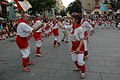 A Ball de bastons stick dance from Catalonia.
 -

-
-
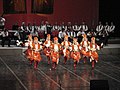
 Podhale Gorals dancing.
 -
 Traditional Russian squat dancing.
.jpg)


See also
[edit]
- List of ethnic, regional, and folk dances sorted by origin
- International folk dance
- Dance basic topics, a list of general dance topics
- Balfolk, contemporary folk dance practised across Europe
References
[edit]- ^ "Folk dance | Definition, Music, History, Types, & Facts | Britannica". www.britannica.com. Retrieved 2022-12-10.
- ^ Buckland, Theresa. "Definitions of Folk Dance: Some Explorations." Folk Music Journal 4, no. 5 (1983): 281–296. JSTOR 4522127.
- ^ a b Zebec, Mira. "Tradition on the Stage: Dance and Transmission between Different Aesthetics." In Dance and Economy / Dance Transmission: Proceedings of the 31st Symposium of the ICTM Study Group on Ethnochoreology, edited by Anne von Bibra Wharton and Dalia Urbanavičienė, 2022. ResearchGate.
- ^ a b Lykesas, Georgios, Koutsouba, Maria, and Tyrovola, Vassiliki. "The Transformation of Traditional Dance from Its First to Its Second Existence." International Journal of Education and Practice 5, no. 10 (2017): 147–157. ERIC EJ1166100.
- ^ Schloss, Joseph G. Foundation: B-boys, B-girls and Hip-Hop Culture in New York. Oxford University Press, 2009.
- ^ a b c d e f Thomas, Helen. The Routledge Encyclopedia of Dance Studies. Routledge, 2014.
- ^ a b Kealiʻinohomoku, Joann. "An Anthropologist Looks at Ballet as a Form of Ethnic Dance." In What Is Dance? Readings in Theory and Criticism, edited by Roger Copeland and Marshall Cohen. Oxford University Press, 1983 (orig. 1970).
- ^ Forrest, John. The History of Morris Dancing, 1458–1750. University of Toronto Press, 2011.
- ^ Sharp, Cecil J., and Karpeles, Maud. The Country Dance Book. London: Novello & Co., 1912.
- ^ Hilton, Wendy. Dance and Music of Court and Theater: Selected Writings of Wendy Hilton. Pendragon Press, 1990.
- ^ Rice, Timothy. Bulgaria: Songs from the Shopi Region. Smithsonian Folkways Recordings, 2003.
- ^ Giurchescu, Anca, and László Felföldi. "Dance as Shared Culture: The Balkans as a Dance Area." In Dance and Society: Dancer as a Cultural Performer, edited by Elsie Ivancich Dunin et al., Nordic Institute of Folk Life, 1994.
- ^ Milošević, Vlastimir. Traditional Dances of Serbia: Their History and Development. Institute of Musicology SASA, 2019.
- ^ Shapiro, Shona. International Folk Dance: A Community for All Ages. Folk Dance Federation of California, 2008.
- ^ Tucker, Jonathan. The Folk Dance Handbook: Learning, Teaching, and Creating Community. Routledge, 2013.
- ^ Rühlmann, André. "The Balfolk Movement: Between Folk Tradition and Contemporary Social Dance." Yearbook for Traditional Music 47 (2015): 145–162.
- ^ Bithell, Caroline, and Juniper Hill, eds. The Oxford Handbook of Music Revival. Oxford University Press, 2014.
- ^ Shay, Anthony. Choreographic Politics: State Folk Dance Companies, Representation, and Power. Wesleyan University Press, 2005.
- ^ a b c Roy, Ananya. Dance in South Asia: Traditions and Transformations. Cambridge University Press, 2010.
- ^ Naroditskaya, Inna. Song from the Land of Fire: Continuity and Change in Azerbaijanian Mugham. Routledge, 2003.
- ^ Nahachewsky, Andriy. Ukrainian Dance: A Cross-Cultural Approach. McFarland, 2012.
- ^ V@DIM. "Golden age". www.turkmenistan.gov.tm.
- ^ Vatsyayan, Kapila. Indian Classical Dance. Publications Division, Government of India, 1974.
- ^ Srivastava, Ranjana. Folk Culture and Oral Tradition in India. Rawat Publications, 2004.
- ^ Wrazen, Louise. “Music and Dance in East and Southeast Asia.” In The Garland Encyclopedia of World Music: East Asia: China, Japan, and Korea, edited by Robert C. Provine, Yosihiko Tokumaru, and J. Lawrence Witzleben. Routledge, 2007.
- ^ Hanna, Judith Lynne. Dance, Sex, and Gender: Signs of Identity, Dominance, Defiance, and Desire. University of Chicago Press, 1988.
- ^ Lytle 2023.
- ^ "Tarian Zapin – Yayasan Warisan Johor". Archived from the original on 2018-09-16. Retrieved 2017-05-25.
Sources
[edit]- Lytle, Tiffany (2023-04-13). "Is My Body My Own?". Conversations Across the Field of Dance Studies. 42. doi:10.3998/conversations.3657. ISSN 2834-6823.
External links
[edit]
- Folk Dance Hawaii
- Dancilla (in German)
- Folklore People Community
- Folk Dance
- Folklore Festivals
- Folklore Festivals Archived 2014-12-18 at the Wayback Machine
- Society for International Folk Dancing
- French Folk Dances, Volume 1 to 3, by Karsten Evers and Ulrike Frydrych, Hildesheim and Eiterfeld, 1982, 1983 and 1987. Dance descriptions (in German), sheet music and audios.[permanent dead link]
| Types | |
|---|---|
| Related |
|

| International | |
|---|---|
| National | |
| Other | |