Art Deco (architecture)
[edit]This article is about the Art Deco movement in regards of architecture. For a general description of the artistic movement, see Art Deco. For a list of buildings, see List of Art Deco architecture.
| Art Deco architecture | |
|---|---|
.jpg)   Top to bottom: Chrysler Building in New York City (1930), Empire State Building (1931), and Théâtre des Champs-Élysées (1913) | |
 Additional media Additional media | |
| Years active | c. 1910s–1950s |
| Location | Global |
Art Deco, short for the French Arts décoratifs (lit. 'Decorative Arts'),[1] is a architectural style that first appeared in Paris in the 1910s before World War I[2] and flourished internationally throughout the 20s and 30s, through styling and design of the exterior and interior of anything. Art Deco has influenced buildings from skyscrapers to cinemas, bridges, ocean liners, trains, cars, trucks, and buses.[3]
During its heyday, Art Deco represented luxury, glamour, exuberance, and faith in social and technological progress. The movement featured rare and expensive materials such as ebony and ivory, and exquisite craftsmanship. It also introduced new materials such as chrome plating, stainless steel, and plastic. In New York, the Empire State Building, Chrysler Building, and other buildings from the 1920s and 1930s are monuments to the style. The largest concentration of Art Deco architecture in the world is in Miami Beach, Florida.[4]
Mike Hope lists many 48 other types of other labels that were used for Art Deco architecture.[5]
Origins
[edit]New materials and technologies
[edit]New materials and technologies, especially reinforced concrete, were key to the development and appearance of Art Deco. The first concrete house was built in 1853 in the Paris suburbs by François Coignet. In 1877, Joseph Monier introduced the idea of strengthening the concrete with a mesh of iron rods in a grill pattern. In 1893, Auguste Perret built the first concrete garage in Paris, then an apartment building, a house, then, in 1913, the Théâtre des Champs-Élysées.[6]
The theatre was denounced by one critic as the "Zeppelin of Avenue Montaigne", an alleged Germanic influence, copied from the Vienna Secession. Thereafter, the majority of Art Deco buildings were made of reinforced concrete, which gave greater freedom of form and less need for reinforcing pillars and columns. Perret was also a pioneer in covering the concrete with ceramic tiles, both for protection and decoration. The architect Le Corbusier first learned the uses of reinforced concrete while working as a draftsman in Perret's studio.[6]
Other new technologies that were important to Art Deco were new methods in producing plate glass, which was less expensive and allowed much larger and stronger windows, and for mass-producing aluminium, which was used for building and window frames and later, by Corbusier, Warren McArthur, and others, for lightweight furniture.
Vienna Secession and Wiener Werkstätte (1897–1912)
[edit]The architects of the Vienna Secession (formed 1897), especially Josef Hoffmann, had a notable influence on Art Deco. His Stoclet Palace, in Brussels (1905–1911), was a prototype of the Art Deco style, featuring geometric volumes, symmetry, straight lines, concrete covered with marble plaques, finely-sculpted ornament, and lavish interiors, including mosaic friezes by Gustav Klimt. Hoffmann was also a founder of the Wiener Werkstätte (1903–1932), an association of craftsmen and interior designers working in the new style. This became the model for the Compagnie des arts français, created in 1919, which brought together André Mare and Louis Süe, the first leading French Art Deco designers and decorators.[7]
-
 Austrian Postal Savings Bank in Vienna by Wagner (1904–1912)
 -
 Detail of the Stoclet Palace's façade, made of reinforced concrete faced with marble veneer

.jpg)
Théâtre des Champs-Élysées (1910–1913)
[edit]%2C_bas-relief%2C_Th%25C3%25A9%25C3%25A2tre_des_Champs_Elys%25C3%25A9es_DSC09313.jpg)
The Théâtre des Champs-Élysées (1910–1913), by Auguste Perret, was the first landmark Art Deco building completed in Paris. Previously, reinforced concrete was only used for industrial and apartment buildings, Perret had built the first modern reinforced-concrete apartment building in Paris on rue Benjamin Franklin in 1903–04. Henri Sauvage, another important future Art Deco architect, built another in 1904 at 7, rue Trétaigne (1904).[8]
From 1908 to 1910, the 21-year-old Le Corbusier worked as a draftsman in Perret's office, learning the techniques of concrete construction. Perret's building had clean rectangular form, geometric decoration and straight lines, the future trademarks of Art Deco. The décor of the theatre was also revolutionary; the façade was decorated with high reliefs by Antoine Bourdelle, a dome by Maurice Denis, paintings by Édouard Vuillard, and an Art Deco curtain by Ker-Xavier Roussel. The theater became the venue for many of the first performances of the Ballets Russes.[8] Perret and Sauvage became the leading Art Deco architects in Paris in the 1920s.[9][10]
Late Art Deco
[edit]-

-
 Palais de Chaillot in Paris by Louis-Hippolyte Boileau, Jacques Carlu and Léon Azéma from the 1937 Paris International Exposition
 -
 Stairway of the Economic and Social Council in Paris, originally the Museum of Public Works, built for the 1937 Exposition, by Auguste Perret (1937)
 -
 High School in King City, California, built by Robert Stanton for the Works Progress Administration (1939)


_(11872278295).jpg)

In 1925, two different competing schools coexisted within Art Deco: the traditionalists, who had founded the Society of Decorative Artists; included the furniture designer Emile-Jacques Ruhlmann, Jean Dunand, the sculptor Antoine Bourdelle, and designer Paul Poiret; they combined modern forms with traditional craftsmanship and expensive materials. On the other side were the modernists, who increasingly rejected the past and wanted a style based upon advances in new technologies, simplicity, a lack of decoration, inexpensive materials, and mass production. The modernists founded their own organization, The French Union of Modern Artists, in 1929. Its members included architects Pierre Chareau, Francis Jourdain, Robert Mallet-Stevens, Corbusier, and, in the Soviet Union, Konstantin Melnikov; the Irish designer Eileen Gray; the French designer Sonia Delaunay; and the jewelers Georges Fouquet and Jean Puiforcat. They fiercely attacked the traditional Art Deco style, which they said was created only for the wealthy, and insisted that well-constructed buildings should be available to everyone, and that form should follow function. The beauty of an object or building resided in whether it was perfectly fit to fulfill its function. Modern industrial methods meant that furniture and buildings could be mass-produced, not made by hand.[11][12][page needed]
The Art Deco interior designer Paul Follot defended Art Deco in this way: "We know that man is never content with the indispensable and that the superfluous is always needed...If not, we would have to get rid of music, flowers, and perfumes..!"[13] However, Le Corbusier was a brilliant publicist for modernist architecture; he stated that a house was simply "a machine to live in", and tirelessly promoted the idea that Art Deco was the past and modernism was the future. Le Corbusier's ideas were gradually adopted by architecture schools, and the aesthetics of Art Deco were abandoned. The same features that made Art Deco popular in the beginning, its craftsmanship, rich materials and ornament, led to its decline. The Great Depression that began in the United States in 1929, and reached Europe shortly afterwards, greatly reduced the number of wealthy clients who could pay for the furnishings and art objects. In the Depression economic climate, few companies were ready to build new skyscrapers.[14] Even the Ruhlmann firm resorted to producing pieces of furniture in series, rather than individual hand-made items. The last buildings built in Paris in the new style were the Museum of Public Works by Auguste Perret (now the French Economic, Social and Environmental Council), the Palais de Chaillot by Louis-Hippolyte Boileau, Jacques Carlu and Léon Azéma, and the Palais de Tokyo of the 1937 Paris International Exposition; they looked out at the grandiose pavilion of Nazi Germany, designed by Albert Speer, which faced the equally grandiose socialist-realist pavilion of Stalin's Soviet Union.
After World War II, the dominant architectural style became the International Style pioneered by Le Corbusier, and Mies van der Rohe. A handful of Art Deco hotels were built in Miami Beach after World War II, but elsewhere the style largely vanished. In the 1960s, it experienced a modest academic revival, thanks in part to the writings of architectural historians such as Bevis Hillier. In the 1970s efforts were made in the United States and Europe to preserve the best examples of Art Deco architecture, and many buildings were restored and repurposed. Postmodern architecture, which first appeared in the 1980s, like Art Deco, often includes purely decorative features.[14][15][16][17]
Styles
[edit]-

-

-

-
 Church of St. Joan of Arc in Nice, France, by Jacques Droz (1934)
 -
 National Diet Building in Tokyo, after a design by Watanabe Fukuzo (1936)
 -
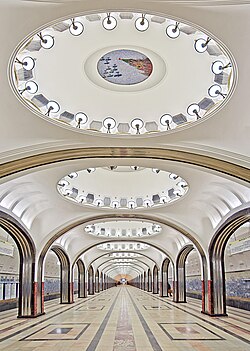
-


Styles
[edit]The architectural style of Art Deco made its debut in Paris in 1903–04, with the construction of two apartment buildings in Paris, one by Auguste Perret on rue Benjamin Franklin and the other on rue Trétaigne by Henri Sauvage. The two young architects used reinforced concrete for the first time in Paris residential buildings; the new buildings had clean lines, rectangular forms, and no decoration on the façades; they marked a clean break with the art nouveau style.[18] Between 1910 and 1913, Perret used his experience in concrete apartment buildings to construct the Théâtre des Champs-Élysées, 15 avenue Montaigne. Between 1925 and 1928 Sauvage constructed the new Art Deco façade of La Samaritaine department store in Paris.[19]
The Art Deco style was not limited to buildings on land; the ocean liner SS Normandie, whose first voyage was in 1935, featured Art Deco design, including a dining room whose ceiling and decoration were made of glass by Lalique.[20]
Art Deco architecture is sometimes classified into three types: Zigzag [Moderne] (aka Jazz Moderne[21]); Classic Moderne; and Streamline Moderne.[22]
Zigzag Moderne
[edit]Zigzag Moderne (aka Jazz Moderne) was the first style to arrive in the United States. "Zigzag" refers to the stepping of the outline of a skyscraper to exaggerate its height,[22][21] and was mainly used for large public and commercial buildings, in particular hotels, movie theaters, restaurants, skyscrapers, and department stores.[23]
Classic Moderne
[edit]Classic Moderne has a more graceful appearance, and there is less ornamentation. Classic Moderne is also sometimes referred to as PWA Moderne or Depression Moderne, as it was undertaken by the PWA during the Great Depression.[23][21][22]
Streamline Moderne
[edit]In the late 1930s, a new variety of Art Deco architecture became common; it was called Streamline Moderne or simply Streamline, or, in France, the Style Paquebot, or Ocean Liner style. Buildings in the style had rounded corners and long horizontal lines; they were built of reinforced concrete and were almost always white; and they sometimes had nautical features, such as railings and portholes that resembled those on a ship. The rounded corner was not entirely new; it had appeared in Berlin in 1923 in the Mossehaus by Erich Mendelsohn, and later in the Hoover Building, an industrial complex in the London suburb of Perivale. In the United States, it became most closely associated with transport; Streamline moderne was rare in office buildings but was often used for bus stations and airport terminals, such as the terminal at La Guardia airport in New York City that handled the first transatlantic flights, via the PanAm Clipper flying boats; and in roadside architecture, such as gas stations and diners. In the late 1930s a series of diners, modelled upon streamlined railroad cars, were produced and installed in towns in New England; at least two examples still remain and are now registered historic buildings.[24]
-
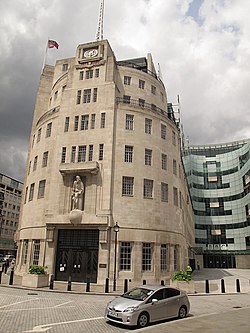 The nautical-style rounded corner of Broadcasting House in London (1931)
 -

-
 The Marine Air Terminal at La Guardia Airport (1937) was New York City's terminal for the flights of Pan Am Clipper flying boats to Europe.
 -
 The Ford Pavilion at the 1939 New York World's Fair


Building types
[edit]Skyscrapers
[edit]-
 The American Radiator Building in New York City by Raymond Hood (1924)
 -
 Empire State Building in New York City by Shreve, Lamb & Harmon (1931)
 -
 Crown of the General Electric Building (also known as 570 Lexington Avenue) in New York City by Cross & Cross (1933)

.jpg)

American skyscrapers marked the summit of the Art Deco style; they became the tallest and most recognizable modern buildings in the world, designed to show the prestige of their builders through height, shape, their color, and dramatic illumination at night.[25] The American Radiator Building by Raymond Hood (1924) combined Gothic and Deco modern elements in the design of the building. Black brick on the frontage of the building (symbolizing coal) was selected to give an idea of solidity and to give the building a solid mass. Other parts of the façade were covered in gold bricks (symbolizing fire), and the entry was decorated with marble and black mirrors. Another early Art Deco skyscraper was Detroit's Guardian Building, which opened in 1929. Designed by modernist Wirt C. Rowland, the building was the first to employ stainless steel as a decorative element, and the extensive use of colored designs in place of traditional ornaments.
New York City's skyline was radically changed by the Chrysler Building in Manhattan (completed in 1930), designed by William Van Alen. It was a giant seventy-seven-floor tall advertisement for Chrysler automobiles. The top was crowned by a stainless steel spire, and was ornamented by deco "gargoyles" in the form of stainless steel radiator cap decorations. The base of the tower, thirty-three stories above the street, was decorated with colorful Art Deco friezes, and the lobby was decorated with Art Deco symbols and images expressing modernity.[26]
The Chrysler Building was soon surpassed in height by the Empire State Building by William F. Lamb (1931), in a slightly less lavish Deco style and the RCA Building (now 30 Rockefeller Plaza) by Raymond Hood (1933) which together completely changed New York City's skyline. The tops of the buildings were decorated with Art Deco crowns and spires covered with stainless steel, and, in the case of the Chrysler building, with Art Deco gargoyles modeled after radiator ornaments, while the entrances and lobbies were lavishly decorated with Art Deco sculpture, ceramics, and design. Similar buildings, though not quite as tall, soon appeared in Chicago and other large American cities. Rockefeller Center added a new design element: several tall buildings grouped around an open plaza, with a fountain in the middle.[27]
Across the Hudson River, Art Deco style skyscrapers were constructed in Newark, New Jersey in the '20s and '30s, namely the New Jersey Bell Headquarters (completed in 1929), designed by Ralph Thomas Walker; the Lefcourt Building (completed in 1930), designed by Frank Grad; and the National Newark Building (completed in 1933), designed by John H. & Wilson C. Ely. John Cotton Dana, head of the Newark Public Library during this period, remarked contemporaneously that these skyscrapers transformed Newark from a "huge, uncouth and unthinking industrial Frankenstein monster into a place of refinement."[28]
"Cathedrals of Commerce"
[edit]-

-
 Lower lobby of the Guardian Building in Detroit by Wirt Rowland (1929)
 -
 Ceiling and chandelier detail on the lobby of the Carew Tower in Cincinnati, Ohio, by Walter W. Ahlschlager (1930)
 -
 Foyer of the Tuschinski Theatre in Amsterdam by Hijman Louis de Jong (1921)

.jpg)


The grand showcases of American Art Deco interior design were the lobbies of government buildings, theaters, and particularly office buildings. Interiors were extremely colorful and dynamic, combining sculpture, murals, and ornate geometric design in marble, glass, ceramics and stainless steel. An early example was the Fisher Building in Detroit, by Joseph Nathaniel French; the lobby was highly decorated with sculpture and ceramics. The Guardian Building (originally the Union Trust Building) in Detroit, by Wirt Rowland (1929), decorated with red and black marble and brightly colored ceramics, highlighted by highly polished steel elevator doors and counters. The sculptural decoration installed in the walls illustrated the virtues of industry and saving; the building was immediately termed the "Cathedral of Commerce". The Medical and Dental Building called 450 Sutter Street in San Francisco by Timothy Pflueger was inspired by Mayan architecture, in a highly stylized form; it used pyramid shapes, and the interior walls were covered with highly stylized rows of hieroglyphs.[29]
In France, the best example of an Art Deco interior during this period was the Palais de la Porte Dorée (1931) by Albert Laprade, Léon Jaussely and Léon Bazin. The building (now the National Museum of Immigration, with an aquarium in the basement) was built for the Paris Colonial Exposition of 1931, to celebrate the people and products of French colonies. The exterior façade was entirely covered with sculpture, and the lobby created an Art Deco harmony with a wood parquet floor in a geometric pattern, a mural depicting the people of French colonies; and a harmonious composition of vertical doors and horizontal balconies.[29]
Movie palaces
[edit]-
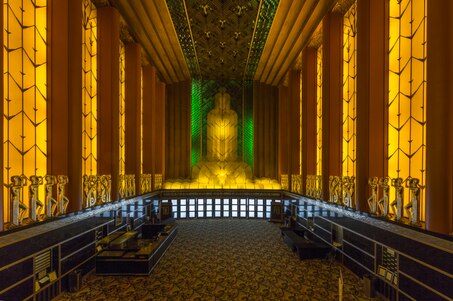 Four-story high grand lobby of the Paramount Theatre in Oakland, California, by Timothy Pflueger (1932)
 -

-


Many of the best surviving examples of Art Deco are cinemas built in the 1920s and 1930s. The Art Deco period coincided with the conversion of silent films to sound, and movie companies built large display destinations in major cities to capture the huge audience that came to see movies. Movie palaces in the 1920s often combined exotic themes with Art Deco style; Grauman's Egyptian Theatre in Hollywood (1922) was inspired by ancient Egyptian tombs and pyramids, while the Fox Theater in Bakersfield, California attached a tower in California Mission style to an Art Deco Hall. The largest of all is Radio City Music Hall in New York City, which opened in 1932. Originally designed as theatrical performance space, it quickly transformed into a cinema, which could seat 6,015 customers. The interior design by Donald Deskey used glass, aluminum, chrome, and leather to create a visual escape from reality. The Paramount Theatre in Oakland, California, by Timothy Pflueger, had a colorful ceramic façade, a lobby four stories high, and separate Art Deco smoking rooms for gentlemen and ladies. Similar grand palaces appeared in Europe. The Grand Rex in Paris (1932), with its imposing tower, was the largest cinema in Europe after the 6,000 seats of the Gaumont-Palace (1931–1973). The Gaumont State Cinema in London (1937) had a tower modelled on the Empire State building, covered with cream ceramic tiles and an interior in an Art Deco-Italian Renaissance style. The Paramount Theatre in Shanghai, China (1933) was originally built as a dance hall called The gate of 100 pleasures; it was converted to a cinema after the Communist Revolution in 1949, and now is a ballroom and disco. In the 1930s Italian architects built a small movie palace, the Cinema Impero, in Asmara in what is now Eritrea. Today, many of the movie theatres have been subdivided into multiplexes, but others have been restored and are used as cultural centres in their communities.[30]
Neo-Art Deco
[edit]-
![Messeturm in Frankfurt, Germany, by Helmut Jahn (1990), a Postmodern building that is reminiscent of Art Deco architecture[31]](//upload.wikimedia.org/wikipedia/commons/thumb/d/d6/Messeturm%2C_Frankfurt%2C_Southwest_detail_view_20170325_1.jpg/250px-Messeturm%2C_Frankfurt%2C_Southwest_detail_view_20170325_1.jpg) Messeturm in Frankfurt, Germany, by Helmut Jahn (1990), a Postmodern building that is reminiscent of Art Deco architecture[31]
Messeturm in Frankfurt, Germany, by Helmut Jahn (1990), a Postmodern building that is reminiscent of Art Deco architecture[31] -
![Rue Henri Heine no. 3–5 in Paris by J.J. Ory (2001), a neo-Art Deco building[32]](//upload.wikimedia.org/wikipedia/commons/thumb/2/25/Rue_Henri_Heine_3.jpg/500px-Rue_Henri_Heine_3.jpg) Rue Henri Heine no. 3–5 in Paris by J.J. Ory (2001), a neo-Art Deco building[32]
Rue Henri Heine no. 3–5 in Paris by J.J. Ory (2001), a neo-Art Deco building[32] -
 Smith Center for the Performing Arts in Las Vegas, Nevada, by David M. Schwarz (2012), a neo-Art Deco building
 -
 The Brooklyn Tower, in New York City (2021), a major neo-Art Deco skyscraper
 -
 Capella Hanoi in Vietnam (2021), a neo-Art Deco building
![Messeturm in Frankfurt, Germany, by Helmut Jahn (1990), a Postmodern building that is reminiscent of Art Deco architecture[31]](https://wikimax.nixinova.com/wp/en/File:Messeturm%2C_Frankfurt%2C_Southwest_detail_view_20170325_1.jpg)
![Rue Henri Heine no. 3–5 in Paris by J.J. Ory (2001), a neo-Art Deco building[32]](https://wikimax.nixinova.com/wp/en/File:Rue_Henri_Heine_3.jpg)


In the 21st century, modern variants of Art Deco, called Neo Art Deco (or neo-Art Deco), have appeared in some American cities, inspired by the classic Art Deco buildings of the 1920s and 1930s.[33] Examples include the NBC Tower in Chicago, inspired by 30 Rockefeller Plaza in New York City; the Smith Center for the Performing Arts in Las Vegas, Nevada, which includes Art Deco call backs to the Hoover Dam; 99 Hudson in Jersey City, New Jersey, the state's tallest building and the 46th tallest in the United States, which features Art Deco-inspired limestone and glass lineation; and the Brooklyn Tower in Brooklyn, New York, the borough's tallest building and the 19th tallest in the country, with its black glass and bronze piping.[33][34][35][36][37][38][39]
Gallery
[edit]-
 Municipal Auditorium of Kansas City, Missouri: Hoit Price & Barnes, and Gentry, Voskamp & Neville (1935)
 -
 Niagara Mohawk Building, Syracuse, N.Y.. Melvin L. King and Bley & Lyman, architects, completed in 1932
 -
 Palacio de Bellas Artes, Mexico City, Federico Mariscal, completed in 1934
 -
 Women's Smoking Room at the Paramount Theatre, Oakland. Timothy L. Pflueger, architect (1931)
 -
 Lobby, Empire State Building, New York City. William F. Lamb, opened in 1931
 -
 Rotunda ceiling of Union Terminal in Cincinnati, Ohio; Paul Philippe Cret, Alfred T. Fellheimer, Steward Wagner, Roland Wank(1933)
 -


.jpg)


See also
[edit]- Roaring Twenties
- 1920s in Western fashion
- Années folles
- 1933 Chicago World's Fair Century of Progress
- 1936 Fair Park built for Texas Centennial Exposition
- Art Deco stamps
References
[edit]- ^ McLaughlin, Katherine; Stamp, Elizabeth (June 26, 2023). "Art Deco Architecture: Everything You Need to Know". Architectural Digest. Retrieved December 28, 2023.
- ^ Texier 2012, p. 128.
- ^ Hillier 1968, p. 12.
- ^ "Miami Beach celebrates 100 years of Art Deco style, culture". CBS news. January 17, 2025. Retrieved January 20, 2025.
- ^ Hope 2019.
- ^ a b Cabanne 1986, p. 225.
- ^ Texier 2019, pp. 5–7.
- ^ a b Hillier, Bevis (1983). The style of the century, 1900–1980. New York: Dutton. pp. 62, 67, 70.
- ^ Collins, Peter (1959). Concrete: The Vision of a New Architecture. New York: Horizon Press.
- ^ Poisson 2009, pp. 318–319.
- ^ Le Corbusier, Vers une architecture, Flammarion, republished in 1995, page xix
- ^ Larousse Encyclopedia on-line edition (in French)[full citation needed]
- ^ Duncan 1988, p. 8.
- ^ a b Cite error: The named reference
Gosswas invoked but never defined (see the help page). - ^ Cite error: The named reference
Art Deco Stylewas invoked but never defined (see the help page). - ^ Fell, Charlotte; Fell, Peter (2006). Design Handbook: Concepts, Materials and Styles (1 ed.). Taschen.
- ^ Heindorf, Anne (July 24, 2006). "Art Deco (1920s to 1930s)". Archived from the original on February 7, 2008. Retrieved November 6, 2008.
- ^ Poisson 2009, pp. 299, 318.
- ^ Plum 2014, p. 134.
- ^ Ardman 1985, pp. 86–87.
- ^ a b c "Art Deco Society of Los Angeles". Art Deco Society of Los Angeles. Retrieved January 10, 2024.
- ^ a b c "Types of Art Deco Architecture". Inviting Home. August 30, 2019. Retrieved January 10, 2024.
- ^ a b "Styles of Art Deco". 508 Park. Retrieved January 10, 2024.
- ^ Duncan 1988, p. 197.
- ^ John Burchard and Albert Bush Brown, The Architecture of America (1966), Atlantic, Little and Brown, page 277
- ^ Benton, Benton & Wood 2003, pp. 249–258.
- ^ Morel 2012, pp. 125–30.
- ^ Di Ionna, Mark (July 2, 2019). "Art Deco Buildings Turned Newark from Frankenstein Monster to Place of Refinement". tapinto.net. Tapinto. Retrieved February 3, 2025.
- ^ a b Duncan 1988, pp. 198–200.
- ^ Duncan 1988, pp. 197–199.
- ^ Criticos, Mihaela (2009). Art Deco sau Modernismul Bine Temperat - Art Deco or Well-Tempered Modernism (in Romanian and English). SIMETRIA. p. 255. ISBN 978-973-1872-03-2.
- ^ Criticos, Mihaela (2009). Art Deco sau Modernismul Bine Temperat - Art Deco or Well-Tempered Modernism (in Romanian and English). SIMETRIA. p. 257. ISBN 978-973-1872-03-2.
- ^ a b Barbara B. Capitman (1994). Rediscovering Art Deco U.S.A. Viking Studio Books. p. 52. ISBN 0525934421.
- ^ "The Smith Center for the Performing Arts". David M. Schwarz Architects, Inc. Retrieved August 24, 2021.
- ^ "Overview". The Smith Center for the Performing Arts. Archived from the original on March 24, 2010.
- ^ "Frequenty Asked Questions (FAQ)". The Smith Center for the Performing Arts. Archived from the original on May 2, 2015. Retrieved March 23, 2013.
- ^ Flamer, Keith (April 11, 2019). "Lifestyle Jersey City's 99 Hudson Soars As America's Third-Tallest Condominium". Forbes. Retrieved February 3, 2025.
- ^ Lange, Alexandra (September 25, 2023). "Downtown Brooklyn Gets the Gotham City Treatment". bloomberg.com. Bloomberg. Retrieved February 3, 2025.
- ^ Davies, Rachel (May 17, 2022). "Exclusive Look Inside Brooklyn's Tallest Skyscraper". architecturaldigest.com. Architectural Digest. Retrieved February 3, 2025.

Genres of modern architecture | |
|---|---|
| Alphabetically |
|
By start year / decade |
|
