Introduction

The visual arts are art forms such as painting, drawing, printmaking, sculpture, ceramics, photography, video, image, filmmaking, design, crafts, and architecture. Many artistic disciplines such as performing arts, conceptual art, and textile arts, also involve aspects of the visual arts, as well as arts of other types. Within the visual arts, the applied arts, such as industrial design, graphic design, fashion design, interior design, and decorative art are also included.
Current usage of the term "visual arts" includes fine art as well as applied or decorative arts and crafts, but this was not always the case. Before the Arts and Crafts Movement in Britain and elsewhere at the turn of the 20th century, the term 'artist' had for some centuries often been restricted to a person working in the fine arts (such as painting, sculpture, or printmaking) and not the decorative arts, crafts, or applied visual arts media. The distinction was emphasized by artists of the Arts and Crafts Movement, who valued vernacular art forms as much as high forms. Art schools made a distinction between the fine arts and the crafts, maintaining that a craftsperson could not be considered a practitioner of the arts.
The increasing tendency to privilege painting, and to a lesser degree sculpture, above other arts has been a feature of Western art as well as East Asian art. In both regions, painting has been seen as relying to the highest degree on the imagination of the artist and being the furthest removed from manual labour – in Chinese painting, the most highly valued styles were those of "scholar-painting", at least in theory practiced by gentleman amateurs. The Western hierarchy of genres reflected similar attitudes. (Full article...)
Selected article

The Princesse de Broglie (French: La Princesse de Broglie [la pʁɛ̃.sɛs də bʁɔj]) is an oil-on-canvas painting by the French Neoclassical artist Jean-Auguste-Dominique Ingres. It was painted between 1851 and 1853, and shows Pauline de Broglie, who adopted the courtesy title 'Princesse'. Born Pauline de Galard de Brassac de Béarn, she married Albert de Broglie, the future 28th prime minister of France, in 1845. Pauline was 28 at the time of the painting's completion. She was highly intelligent and widely known for her beauty, but she suffered from profound shyness and the painting captures her melancholia. Pauline contracted tuberculosis in her early 30s and died in 1860 aged 35. Although Albert lived until 1901, he was heartbroken and did not remarry.
Ingres undertook a number of preparatory pencil sketches for the commission, each of which captures her personality and taste. They show her in various poses, including standing, and in differently styled dresses. The final painting is considered one of Ingres's finest later-period portraits of women, along with the Portraits of Comtesse d'Haussonville, Baronne de Rothschild and Madame Moitessier. As with many of Ingres's portraits of women, details of the costume and setting are rendered with precision while the body seems to lack a solid bone structure. The painting is held in the collection of the Metropolitan Museum of Art, New York, and is signed and dated 1853. (Full article...)
Selected picture

Selected quote
| “ | Many are willing to suffer for their art. Few are willing to learn to draw. | ” |
| — Simon Munnery, Attention Scum! |
Related portals


Selected biography

James Barton Longacre (August 11, 1794 – January 1, 1869) was an American portraitist and engraver, and the fourth chief engraver of the United States Mint from 1844 until his death. Longacre is best known for designing the Indian Head cent, which entered commerce in 1859, and for the designs of the Shield nickel, Flying Eagle cent and other coins of the mid-19th century.
Longacre was born in Delaware County, Pennsylvania, in 1794. He ran away to Philadelphia at age 12, where he became an apprentice in a bookstore. His artistic talent developed and he was released to apprentice in an engraving firm. He struck out on his own in 1819, making a name providing illustrations for popular biographical books. He portrayed the leading men of his day; support from some of them, such as South Carolina Senator John C. Calhoun, led to his appointment as chief engraver after the death of Christian Gobrecht in 1844. (Full article...)
Did you know (auto generated) -

- ... that two books of photos and drawings by Margot Dias were called "among the best-illustrated anthropological volumes ever produced"?
- ... that Diane Orr and C. Larry Roberts were once said to "epitomize the regional, independent filmmaker"?
- ... that Graham Crowley entered the John Moores Painting Prize ten times since 1976 before finally winning in 2023?
- ... that the earliest surviving silk-scroll painting from Gangwon Province was found in an attic in Hopkinton, New Hampshire?
- ... that Sculpture Space lets artists create large-scale works in a former metalworking shop?
- ... that Mayu Sakai found drawing Peter Pan Syndrome difficult because of its fantasy elements?
- ... that The Wiccan Web recommends drawing pentagrams on your computer screen with tinctures?
- ... that the early woman explorer Adèle de Dombasle travelled to Polynesia in 1847 and worked as an illustrator, drawing people such as Queen Pōmare IV?
General images
-
 Book of Hours (from History of painting)
 -

-
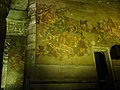 A fresco from Cave 1 of Ajanta. (from History of painting)
 -
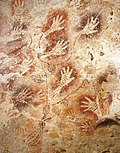 Hand stencils in the "Tree of Life" cave painting in Gua Tewet, Kalimantan, Indonesia (from History of painting)
 -
 Pictographs from the Great Gallery, Canyonlands National Park, Horseshoe Canyon, Utah, c. 1500 BCE (from History of painting)
 -
 Golden section in book design (from Graphic design)
 -

-

-
 The Sakyamuni Buddha, by Zhang Shengwen, 1173–1176 AD, Song dynasty period. (from History of painting)
 -
 Cueva de las Manos (Spanish for Cave of the Hands) in the Santa Cruz province in Argentina, c. 7300 BC (from History of painting)
 -
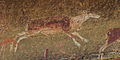
-
 Max Beckmann, The Night (Die Nacht), 1918–1919, Kunstsammlung Nordrhein-Westfalen, Düsseldorf (from History of painting)
 -

-
 Cover of the Thanksgiving 1895 issue of The Chap-Book, designed by Will H. Bradley (from Graphic design)
 -

-
 Loquats and Mountain Bird, anonymous artist of the Southern Song dynasty; paintings in leaf album style such as this were popular in the Southern Song (1127–1279). (from History of painting)
 -

-
 Due to its interdisciplinary nature, graphic design can be performed in different areas of application: branding, technical and artistic drawing, signage, photography, image and video editing, 3D modeling, animation, programming, among other fields. (from Graphic design)
 -
 Wayang beber, 17th century (from History of painting)
 -

-
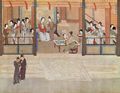 Spring Morning in the Han Palace, by Ming-era artist Qiu Ying (1494–1552 AD) (from History of painting)
 -

-
 A Chinese painted jar from the Western Han Era (202 BCE – 9 CE) (from History of painting)
 -
 Mother Goddess A miniature painting of the Pahari style, dating to the eighteenth century. Pahari and Rajput miniatures share many common features. (from History of painting)
 -
 In 2021, researchers discovered ancient cave art in Leang Tedongnge, Sulawesi, Indonesia, estimated to be at least 45,500 years old. Depicting a warty pig, this artwork is recognized as the world's oldest known example of figurative or representational art. (from History of painting)
 -
-
 Joan Miró, Horse, Pipe and Red Flower, 1920, abstract Surrealism, Philadelphia Museum of Art (from History of painting)
 -
-

-
 Colour (from Graphic design)
 -
 The Eternal Father Painting the Virgin of Guadalupe. Attributed to Joaquín Villegas (1713 – active in 1753) (Mexican) (painter, Museo Nacional de Arte. (from History of painting)
 -
-
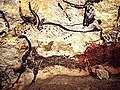
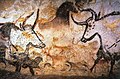 Lascaux, Bulls and Horses (from History of painting)
 -

-

-
 Francis Picabia, (Left) Le saint des saints c'est de moi qu'il s'agit dans ce portrait, 1 July 1915; (center) Portrait d'une jeune fille americaine dans l'état de nudité, 5 July 1915: (right) J'ai vu et c'est de toi qu'il s'agit, De Zayas! De Zayas! Je suis venu sur les rivages du Pont-Euxin, New York, 1915 (from History of painting)
 -
 Two Scribes Seated with Books and a Writing Table Fragment of a decorative margin Northern India (Mughal school), ca. 1640–1650 (from History of painting)
 -
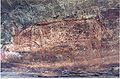
 Gwion Gwion rock paintings found in the north-west Kimberley region of Western Australia c. 15,000 BC (from History of painting)
 -
 Spanish cave painting of Bulls (from History of painting)
 -
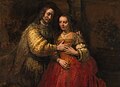 Rembrandt van Rijn, The Jewish Bride, ca. 1665–1669 (from History of painting)
 -

-
 Diego Rivera, Recreation of Man at the Crossroads (renamed Man, Controller of the Universe), originally created in 1934, Mexican muralism movement (from History of painting)
 -
-

-

-
 Graphic symbols are often functionalist and anonymous, as these pictographs from the US National Park Service illustrate. (from Graphic design)
 -
 An Ethiopian illuminated Evangelist portrait of Mark the Evangelist, from the Ethiopian Garima Gospels, 6th century AD, Kingdom of Aksum (from History of painting)
 -

-
 Bharat Mata by Abanindranath Tagore (1871–1951), a nephew of the poet Rabindranath Tagore, and a pioneer of the movement (from History of painting)
 -

-
-
 A fresco showing Hades and Persephone riding in a chariot, from the tomb of Queen Eurydice I of Macedon at Vergina, Greece, 4th century BC (from History of painting)
 -

-
 Lascaux, Horse (from History of painting)
 -

-
 A Boeing 747 aircraft with livery designating it as Air Force One. The cyan forms, the US flag, presidential seal and the Caslon lettering, were all designed at different times, by different designers, for different purposes, and combined by designer Raymond Loewy in this one single aircraft exterior design. (from Graphic design)
 -
 Silk painting depicting a man riding a dragon, painting on silk, dated to 5th–3rd century BC, Warring States period, from Zidanku Tomb no. 1 in Changsha, Hunan Province (from History of painting)
 -

-
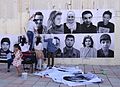 Irbid, Jordan, "We are Arabs. We are Humans". Inside Out is a global participatory art project, initiated by the French photographer JR, an example of Street art. (from Contemporary art)
 -
-
 Young Mother Sewing, Mary Cassatt (from History of painting)
 -
 Poster to promote the Centennial of Argentina (1910) (from Graphic design)
 -
 Muromachi period, Shingei (1431–1485), Viewing a Waterfall, Nezu Museum, Tokyo. (from History of painting)


.JPG)


%2C_oil_on_canvas%2C_133_x_154_cm%2C_Kunstsammlung_Nordrhein-Westfalen%2C_D%25C3%25BCsseldorf.jpg)


.jpg)


%2527_by_Barnett_Newman%2C_1968.jpg)


.jpg)

.jpg)


Major topics
- Types of visual art – Architecture • Art intervention • Ceramic art • Computer art • Drawing • Fashion • Film • Installation art • Land art • Mixed media • Painting • Performance art • Photography • Printmaking • Sculpture • Stained glass; • Artists' Books
- Art history – Pre-historic art • Ancient art • Art of Ancient Egypt • Art in Ancient Greece • Minoan pottery • Scythian art • Roman art • Women artists
- Western art periods and movements – Medieval art • Gothic art • Renaissance • Mannerism • Baroque • Rococo • Neoclassicism • Romanticism • Realism • Modern Art • Impressionism • Symbolism • Fauvism • Proto-Cubism • Cubism • Futurism • Dada • Art Deco • Surrealism • Abstract Expressionism • Lyrical abstraction • Conceptual Art • Contemporary Art • Postmodern art visual arts.
- Eastern and Middle Eastern art – Buddhist art • Chinese art • Islamic art • Japanese art • Laotian art • Thai art • Tibetan art
- Lists – Architects • Art movements • Art periods • Painters • Printmakers • Sculptors • Statues
- Lists of basic topics – Visual arts • Architecture • Film • Painting • Photography • Sculpture
Subcategories

Architecture | Ceramic art | Comics | Crafts | Design | Drawing | Illustration | Film | Glass | Graphic design | Industrial design | Landscape architecture | Multimedia | Painting | Photography | Pottery | Printmaking | Public art | Sculpture | Typography | Mosaic
Artists | Visual arts awards | Artist collectives | Art collectors | Art critics | Art curators | Visual arts exhibitions | Art forgery | Art history | Visual arts materials | Art schools | Artistic techniques |
WikiProjects
Things you can do

Associated Wikimedia
The following Wikimedia Foundation sister projects provide more on this subject:
-
Commons
Free media repository -
Wikibooks
Free textbooks and manuals -
Wikidata
Free knowledge base -
Wikinews
Free-content news -
Wikiquote
Collection of quotations -
Wikisource
Free-content library -
Wikiversity
Free learning tools -
Wiktionary
Dictionary and thesaurus