The Solar System Portal

The Solar System is the gravitationally bound system of the Sun and the masses that orbit it, most prominently its eight planets, of which Earth is one. The system formed about 4.6 billion years ago when a dense region of a molecular cloud collapsed, creating the Sun and a protoplanetary disc from which the orbiting bodies assembled. Inside the Sun's core hydrogen is fused into helium for billions of years, releasing energy which is over even longer periods of time emitted through the Sun's outer layer, the photosphere. This creates the heliosphere and a decreasing temperature gradient across the Solar System.
The mass of the Solar System is by 99.86% almost completely made up of the Sun's mass. The next most massive objects of the system are the eight planets, which by definition dominate the orbits they occupy. Closest to the Sun in order of increasing distance are the four terrestrial planets – Mercury, Venus, Earth and Mars. These are the planets of the inner Solar System. Earth and Mars are the only planets in the Solar System which orbit within the Sun's habitable zone, in which the sunlight can make surface water under atmospheric pressure liquid. Beyond the frost line at about five astronomical units (AU), are two gas giants – Jupiter and Saturn – and two ice giants – Uranus and Neptune. These are the planets of the outer Solar System. Jupiter and Saturn possess nearly 90% of the non-stellar mass of the Solar System.
Additionally to the planets there are in the Solar System other planetary-mass objects, but which do not dominate their orbits, such as dwarf planets and planetary-mass moons. Dwarf planets there are generally nine Solar System objects identified as such: Ceres, Orcus, Pluto, Haumea, Quaoar, Makemake, Gonggong, Eris, and Sedna. Natural satellites, which are commonly called 'moons', can be found throughout the Solar System and in sizes from planetary-mass moons to much less massive moonlets at their smallest. The largest two moons (Ganymede of Jupiter and Titan of Saturn) are larger than the smallest planet (Mercury), while the seven most massive, which includes Earth's Moon, are more massive and larger than any of the dwarf planets. Less massive than these planetary-mass objects are the vast number of small Solar System bodies, such as asteroids, comets, centaurs, meteoroids, and interplanetary dust clouds. All dwarf planets and many of the smaller bodies are within the asteroid belt (between Mars's and Jupiter's orbit) and the Kuiper belt (just outside Neptune's orbit).
The Solar System is within the heliosphere constantly flooded by the charged plasma particles of the solar wind, which forms with the interplanetary dust, gas and cosmic rays between the bodies of the Solar System an interplanetary medium. At around 70–90 AU from the Sun, the solar wind is halted by the interstellar medium, resulting in the heliopause and the border of the interplanetary medium to interstellar space. Further out somewhere beyond 2,000 AU from the Sun extends the outermost region of the Solar System, the theorized Oort cloud, the source for long-period comets, stretching to the edge of the Solar System, the edge of its Hill sphere, at 178,000–227,000 AU (2.81–3.59 ly), where its gravitational potential becomes equal to the galactic potential. The Solar System currently moves through a cloud of interstellar medium called the Local Cloud. The closest star to the Solar System, Proxima Centauri, is 269,000 AU (4.25 ly) away. Both are within the Local Bubble, a relatively small 1,000 light-years (ly) wide region of the Milky Way. (Full article...)
Selected article –

Selected picture
-
 Animation: NASA/JPL/University of ArizonaA 14-frame clip showing the atmosphere of Jupiter as viewed from the NASA probe Cassini. Taken over a span of 24 Jupiter rotations between October 31 and November 9, 2000, this clip shows various patterns of motion across the planet. The Great Red Spot rotates counterclockwise, and the uneven distribution of its high haze is obvious. To the east (right) of the Red Spot, oval storms, like ball bearings, roll over and pass each other. East-west bands adjacent to each other move at different rates. Strings of small storms rotate around northern-hemisphere ovals. The large grayish-blue "hot spots" at the northern edge of the white Equatorial Zone change over time as they proceed eastward across the planet. Ovals in the north rotate counter to those in the south. Small, very bright features appear quickly and randomly in turbulent regions, possibly lightning storms. The smallest visible features at the equator are about 600 km (370 miles) across.
 -


Solar eclipse of 11 August 1999 The solar eclipse of 1999 August 11, as seen from France. This was the most viewed total eclipse in human history, although some areas offered impaired visibility due to adverse weather conditions. The path of the Moon's shadow began in the Atlantic Ocean, before traversing Cornwall, northern France, southern Germany, Austria, Hungary and northern Serbia. Its maximum was in Romania, and it continued across the Black Sea, Turkey, Iran, southern Pakistan and India. -
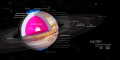 Diagram: Kelvin SongA diagram of Jupiter showing a model of the planet's interior, with a rocky core overlaid by a deep layer of liquid metallic hydrogen and an outer layer predominantly of molecular hydrogen. Jupiter's true interior composition is uncertain. For instance, the core may have shrunk as convection currents of hot liquid metallic hydrogen mixed with the molten core and carried its contents to higher levels in the planetary interior. Furthermore, there is no clear physical boundary between the hydrogen layers—with increasing depth the gas increases smoothly in temperature and density, ultimately becoming liquid.
 -
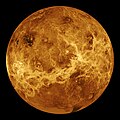 Image credit: NASAA radar image of the surface of Venus, centered at 180 degrees east longitude. This composite image was created from mapping by the Magellan probe, supplemented by data gathered by the Pioneer orbiter, with simulated hues based on color images recorded by Venera 13 and 14. No probe has been able to survive more than a few hours on Venus's surface, which is completely obscured by clouds, because the atmospheric pressure is some 90 times that of the Earth's, and its surface temperature is around 450 °C (842 °F).
 -
 Photo: NASA/ISS Expedition 23 crewThe aurora australis, as seen from the International Space Station. Aurorae are natural light displays in the sky caused by the collision of energetic charged particles with atoms in the high altitude thermosphere. The particles originate in the magnetosphere and solar wind and, on Earth, are directed by Earth's magnetic field into the atmosphere.
 -
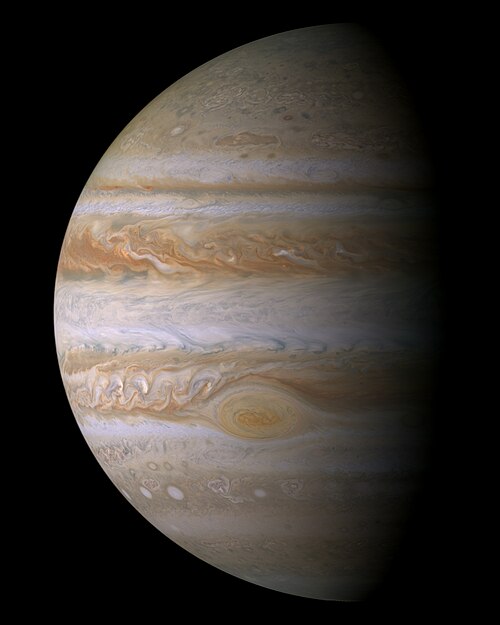
Jupiter Credit: Cassini probeJupiter is the fifth planet from the Sun and by far the largest within the Solar System. It is 318 times more massive than Earth, with a diameter 11 times that of Earth, and with a volume 1300 times that of Earth. Its best known feature is the Great Red Spot, a storm larger than Earth, which was first observed by Galileo four centuries ago. This picture, taken by the Cassini orbiter was one of 26 thousand images taken of Jupiter during the course of its flyby and is the most detailed global color portrait of the planet ever produced. -
 Photo credit: Cassini orbiterHyperion, a moon of Saturn, is one of the largest highly irregular (non-spherical) bodies in the Solar System. Enhanced image processing was used to bring out details and color differences in this photo taken by the Cassini orbiter. Hyperion is entirely saturated with deep, sharp-edged craters that give it the appearance of a giant sponge. Dark material fills the bottom of each crater.
 -
These images are composites of the complete radar image collection obtained by the Magellan mission. The Magellan spacecraft was launched aboard Space Shuttle Atlantis in May 1989 and began mapping the surface of Venus in September 1990. The spacecraft continued to orbit Venus for four years, returning high-resolution images, altimetry, thermal emissions and gravity maps of 98 percent of the surface. Magellan spacecraft operations ended on October 12, 1994, when the radio contact was lost with the spacecraft during its controlled descent into the deeper portions of the Venusian atmosphere.
-
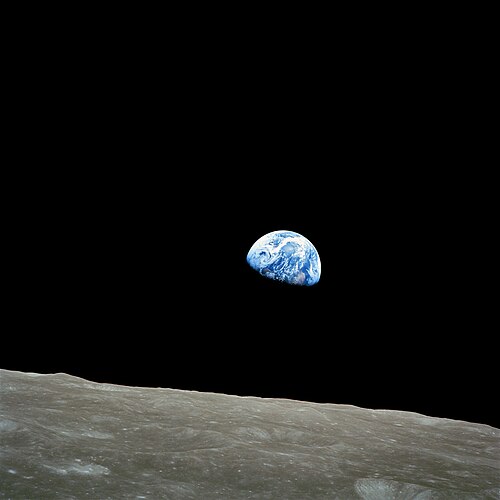
Earthrise, as seen by Apollo 8 Credit: William AndersEarthrise, the first occasion in which humans saw the Earth seemingly rising above the surface of the Moon, taken during the Apollo 8 mission on December 24, 1968. This view was seen by the crew at the beginning of its fourth orbit around the Moon, although the first photograph taken was in black-and-white. Note that the Earth is in shadow here. A photo of a fully lit Earth would not be taken until the Apollo 17 mission. -
 Lakes of methane on TitanImage credit: Cassini orbiterThis false-color radar image taken by the Cassini orbiter provides convincing evidence for large bodies of liquid methane on Titan. Images taken during a fly-by of the moon on July 22, 2006 show more than 75 large bodies of liquid ranging in diameter from three to 70km (1.9 to 43.6 mi) in the moon's northern hemisphere. Intensity in this colorized image is proportional to how much radar brightness is returned. The lakes, darker than the surrounding terrain, are emphasized here by tinting regions of low backscatter in blue. Radar-brighter regions are shown in tan. Smallest details in this image are about 500 m (1,640 ft) across. On January 3, 2007, NASA announced that scientists have "definitive evidence of lakes filled with methane on Saturn's moon Titan."
 -
 Photo credit: Cassini orbiterThis polar map of Jupiter, taken by the Cassini orbiter as it neared Jupiter during a flyby on its way to Saturn, is the most detailed global color map of the planet ever produced. The south pole is in the center of the map and the equator is at the edge. The map shows a variety of colorful cloud features, including parallel reddish-brown and white bands, the Great Red Spot, multi-lobed chaotic regions, white ovals, and many small vortexes. Many clouds appear in streaks and waves due to continual stretching and folding by Jupiter's winds and turbulence.
 -
Mars, the fourth planet from the Sun, is named after the Roman god of war because of its blood red color. Mars has two small, oddly-shaped moons, Phobos and Deimos, named after the sons of the Greek god Ares. At some point in the future Phobos will be broken up by gravitational forces. The atmosphere on Mars is 95% carbon dioxide. In 2003 methane was also discovered in the atmosphere. Since methane is an unstable gas, this indicates that there must be (or have been within the last few hundred years) a source of the gas on the planet.
-
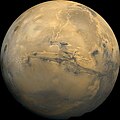 Photo credit: NASAMars, the fourth planet from the Sun, is named after the Roman god of war because of its blood red color. Mars has two small, oddly-shaped moons, Phobos and Deimos, named after the sons of the Greek god Ares. At some point in the future Phobos will be broken up by gravitational forces.
 -
 Photo credit: Mars Reconnaissance OrbiterPhobos, the larger and closer of the two moons of Mars, as seen from about 6,000 kilometres (3,700 mi) away. A small, irregularly shaped object, Phobos orbits about 9,377 km (5,827 mi) from the center of Mars, closer to its primary than any other planetary moon. The illuminated part of Phobos seen in the images is about 21 km (13 mi) across. The most prominent feature in the images is the large crater Stickney in the lower right. With a diameter of 9 km (5.6 mi), it is the largest feature on Phobos.
 -
 Photo credit: Cassini orbiterA close-up of 10 km (6.2 mi) high mountains within the equatorial ridge on Saturn's moon Iapetus, photographed by the Cassini orbiter. Above the middle of the image can be seen a place where an impact has exposed the bright ice beneath the dark overlying material. The image was taken on September 10, 2007, with the Cassini spacecraft narrow-angle camera at a distance of approximately 3,870 km (2,400 mi) from Iapetus.
 -
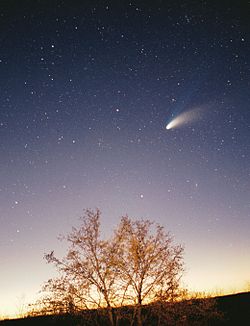
Comet Hale-Bopp 29-03-1997 Credit: Philipp SalzgeberComet Hale–Bopp sails across the sky in the vicinity of Pazin in Istria, Croatia. To the lower right of the comet the Andromeda Galaxy is also faintly visible. The comet was visible to the naked eye for a record 18 months, twice as long as the Great Comet of 1811. At perihelion, it shone brighter than any star in the sky except Sirius, and its two tails stretched 30-40 degrees across the sky. The passage of Hale-Bopp was notable also for inciting a degree of panic about comets not seen for decades. Rumours that the comet was being followed by an alien spacecraft inspired a mass suicide among followers of the Heaven's Gate cult. -
 Photo credit: The Apollo 17 crewThe Blue Marble is a famous photograph of Earth. NASA officially credits the image to the entire Apollo 17 crew — Eugene Cernan, Ronald Evans and Jack Schmitt — all of whom took photographic images during the mission. Apollo 17 passed over Africa during daylight hours and Antarctica is also illuminated. The photograph was taken approximately five hours after the spacecraft's launch, while en route to the Moon. Apollo 17, notably, was the last manned lunar mission; no humans since have been at a range where taking a "whole-Earth" photograph such as "The Blue Marble" would be possible.
 -
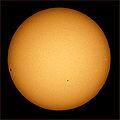 The transit of Mercury across the face of the Sun that took place in November 2006. Mercury appears as a black speck in the Sun's lower center-right region; the black areas on the left and right edges are sunspots. The transit was first recorded by French astronomer Pierre Gassendi on November 7, 1631. Transits of Mercury take place in May or November, at intervals of 7, 13, or 33 years, with the next one scheduled to appear in May 2016.
 -
A TRACE image of sunspots on the surface, or photosphere, of the Sun from September 2002, is taken in the far ultraviolet on a relatively quiet day for solar activity. However, the image still shows a large sunspot group visible as a bright area near the horizon. Although sunspots are relatively cool regions on the surface of the Sun, the bright glowing gas flowing around the sunspots have a temperature of over one million °C (1.8 million °F). The high temperatures are thought to be related to the rapidly changing magnetic field loops that channel solar plasma.
-
 The Milky Way is the galaxy that contains the Solar System, with the name describing the galaxy's appearance from Earth: a hazy band of light seen in the night sky formed from stars that cannot be individually distinguished by the naked eye. The term Milky Way is a translation of the Latin via lactea, from the Greek γαλαξίας κύκλος (galaxías kýklos, 'milky circle'). From Earth, the Milky Way appears as a band because its disk-shaped structure is viewed from within. Galileo Galilei first resolved the band of light into individual stars with his telescope in 1610. Until the early 1920s, most astronomers thought that the Milky Way contained all the stars in the Universe. Following the 1920 Great Debate between the astronomers Harlow Shapley and Heber Curtis, observations by Edwin Hubble showed that the Milky Way is just one of many galaxies.
This picture shows a portion of the Milky Way as seen from Cerro Paranal in Chile, home to the European Southern Observatory (ESO)'s Very Large Telescope, depicting the region spanning the constellations from Sagittarius to Scorpius. The colourful nebulae surrounding Rho Ophiuchi and Antares can be seen to the right, while the dusty lane of the galaxy runs obliquely through the image, dotted with reddish objects such as the Lagoon and Trifid Nebulae. This region of the Milky Way also includes the Galactic Center, likely containing a supermassive black hole, Sagittarius A*. -
 Model: NickshanksLunar distance is a measurement of the distance from the Earth to the Moon. This diagram shows the distance, averaging 384,400 km (238,900 mi), to scale, as well as the Earth and the Moon (scroll to see the entire image).
 -
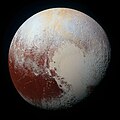 Photograph: NASA / Johns Hopkins University Applied Physics Laboratory / Southwest Research InstitutePluto is a dwarf planet in the Kuiper belt, a ring of bodies beyond Neptune. Discovered by Clyde Tombaugh in 1930, Pluto was originally considered to be the ninth planet from the Sun. Following the discovery of several objects of similar size in the Kuiper belt, its status as a planet was questioned, and in 2006 the International Astronomical Union (IAU) gave a definition of the term "planet" that excluded Pluto. The largest and second-most-massive known dwarf planet in the Solar System, Pluto is primarily made of ice and rock. It is relatively small, with a moderately eccentric and inclined orbit.
This photograph of Pluto is a composite of four near-true color images taken by the New Horizons spacecraft in 2015. The most prominent feature in the image, the bright, youthful, nitrogen ice plains of Sputnik Planitia, the left lobe of heart-shaped Tombaugh Regio, is at right center. This contrasts with the darker, more cratered terrain of Cthulhu Macula at lower left. -
 Photo credit: Voyager 1False-color detail of Jupiter's atmosphere, imaged by Voyager 1, showing the Great Red Spot and a passing white oval. The wavy cloud pattern to the left of the Red Spot is a region of extraordinarily complex and variable wave motion. To give a sense of Jupiter's scale, the white oval storm directly below the Great Red Spot is approximately the same diameter as Earth.


General images
The following are images from various Solar System-related articles on Wikipedia.
-
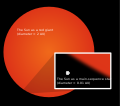 Relative size of the Sun as it is now (inset) compared to its estimated future size as a red giant (from Formation and evolution of the Solar System)
 -
 An artist's impression of the Oort cloud, a region still well within the sphere of influence of the Solar System, including a depiction of the much further inside Kuiper belt (inset); the sizes of objects are over-scaled for visibility. (from Solar System)
 -
 Overview of the inner Solar System up to Jupiter's orbit (from Solar System)
 -
 Pierre-Simon Laplace, one of the originators of the nebular hypothesis (from Formation and evolution of the Solar System)
 -
 Comparison of the distances between planets, with the white bar showing orbital variations. The size of the planets is not to scale. (from Solar System)
 -
![Image 6Diagram of the Local Interstellar Cloud, the G-Cloud and surrounding stars. As of 2022[update], the exact position of the Solar System within the interstellar clouds remains an unresolved question in astronomy. (from Solar System)](//upload.wikimedia.org/wikipedia/commons/thumb/7/7c/The_Local_Interstellar_Cloud_and_neighboring_G-cloud_complex.svg/120px-The_Local_Interstellar_Cloud_and_neighboring_G-cloud_complex.svg.png) Diagram of the Local Interstellar Cloud, the G-Cloud and surrounding stars. As of 2022[update], the exact position of the Solar System within the interstellar clouds remains an unresolved question in astronomy. (from Solar System)
Diagram of the Local Interstellar Cloud, the G-Cloud and surrounding stars. As of 2022[update], the exact position of the Solar System within the interstellar clouds remains an unresolved question in astronomy. (from Solar System) -
 Artist's conception of a protoplanetary disk (from Formation and evolution of the Solar System)
 -
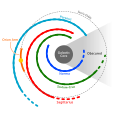 Location of the Solar System within the Milky Way (from Formation and evolution of the Solar System)
 -
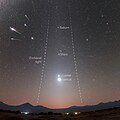 The planets, zodiacal light and meteor shower (top left of image) (from Solar System)
 -
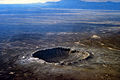 Meteor Crater in Arizona. Created 50,000 years ago by an impactor about 50 metres (160 ft) across, it shows that the accretion of the Solar System is not over. (from Formation and evolution of the Solar System)
 -
 The motion of 'lights' moving across the sky is the basis of the classical definition of planets: wandering stars. (from Solar System)
 -
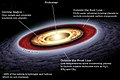 Diagram of the early Solar System's protoplanetary disk, out of which Earth and other Solar System bodies formed (from Solar System)
 -
 The orbital eccentricities and inclinations of the scattered disc population compared to the classical and resonant Kuiper belt objects (from Solar System)
 -
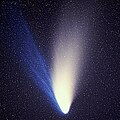 The sparse plasma (blue) and dust (white) in the tail of comet Hale–Bopp are being shaped by pressure from solar radiation and the solar wind, respectively.
 -
 Diagram of the Sun's magnetosphere and helioshealth (from Solar System)
 -
 All active Solar System space probes in 2024 (and a list of upcoming ones) (from Solar System)
 -
 Orbit classification of Kuiper belt objects. Some clusters that is subjected to orbital resonance are marked. (from Solar System)
 -
 The Solar System (left) within the interstellar medium, with the different regions and their distances on a logarithmic scale (from Solar System)
 -
 The Ring Nebula, a planetary nebula similar to what the Sun will become (from Formation and evolution of the Solar System)
 -
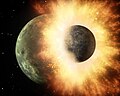 Artist's conception of the giant impact thought to have formed the Moon (from Formation and evolution of the Solar System)
 -
 Relative orbital distances in the Solar System visualized as a condensed rectangle (from Solar System)
 -
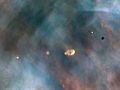 Hubble image of protoplanetary discs in the Orion Nebula, a stellar nursery approximately 25 ly across and estimated to be similar to the primordial nebula from which the Sun formed (from Formation and evolution of the Solar System)
 -
 A color enhanced photograph from the Moon of a range of components of the Solar System. The three dots at the lower left are from left to right the planets Saturn, Mars, and Mercury, and in the middle of the picture rises the Sun's corona over the dark limb of the Moon, which is from the right lit by earthshine. (from Solar System)
 -
 Neptune and its moon Triton, taken by Voyager 2. Triton's orbit will eventually take it within Neptune's Roche limit, tearing it apart and possibly forming a new ring system. (from Formation and evolution of the Solar System)
 -
 Animations of the Solar System's inner planets orbiting. Each frame represents 2 days of motion. (from Solar System)
 -

-
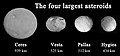 The four largest asteroids: Ceres, Vesta, Pallas, Hygiea. Only Ceres and Vesta have been visited by a spacecraft and thus have a detailed picture. (from Solar System)
 -
 Animations of the Solar System's outer planets orbiting. This animation is 100 times faster than the inner planet animation. (from Solar System)
 -
 Solar system diagram by Emanuel Bowen in 1747, when neither Uranus, Neptune, nor the asteroid belts had yet been discovered. Orbits of planets are to scale, but the orbits of moons and the sizes of bodies are not. (from Solar System)
 -
 Simulation showing outer planets and Kuiper belt:
a) Before Jupiter/Saturn 2:1 resonance
b) Scattering of Kuiper belt objects into the Solar System after the orbital shift of Neptune
c) After ejection of Kuiper belt bodies by JupiterOrbit of JupiterOrbit of SaturnOrbit of UranusOrbit of Neptune(from Formation and evolution of the Solar System) -
The current Sun compared to its peak size in the red-giant phase (from Solar System)
-
 The current orbits of Sedna, 2012 VP113, Leleākūhonua (pink), and other very distant objects (red, brown and cyan) along with the predicted orbit of the hypothetical Planet Nine (dark blue) (from Solar System)
 -
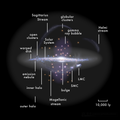 Diagram of the Milky Way, with galactic features and the relative position of the Solar System labeled. (from Solar System)
 -
 The outer planets Jupiter, Saturn, Uranus and Neptune, compared to the inner planets Earth, Venus, Mars, and Mercury at the bottom right (from Solar System)
 -
 Plot of objects around the Kuiper belt and other asteroid populations. J, S, U and N denotes Jupiter, Saturn, Uranus and Neptune. (from Solar System)
 -
 The Sun in true white color (from Solar System)


![Image 6Diagram of the Local Interstellar Cloud, the G-Cloud and surrounding stars. As of 2022[update], the exact position of the Solar System within the interstellar clouds remains an unresolved question in astronomy. (from Solar System)](https://wikimax.nixinova.com/wp/en/File:The_Local_Interstellar_Cloud_and_neighboring_G-cloud_complex.svg)


.jpg)


.jpg)


.jpg)


Did you know –

- ...that New York's Panther Mountain (pictured) was the site of a prehistoric meteor crash?
- ...that the Beethoven crater in the Beethoven quadrangle on Mercury is the eleventh largest named impact crater in the Solar System?
- ...that the planet Mars appears red primarily because of a ubiquitous layer of dust containing nanophase ferric oxides?
- ...that the 1997 volcanic eruption of Pillan Patera on Jupiter's moon Io was the largest effusive eruption ever witnessed?
- ...that the south pole of the planet Mercury is located in the Bach quadrangle?
- ...that the Sweden Solar System is currently the world's largest scale model of the Solar System?
- ...that the dominant feature in the Shakespeare quadrangle is the 1300 km wide Caloris Planitia, the largest and best preserved impact basin on Mercury observed by the spacecraft Mariner 10?
- ...that the nearly circular shape of Lukanga Swamp, a wetland covering 2,600 km² in Central Province, Zambia, has led to speculation that it may be a crater formed by the impact of a meteorite?
Categories

|
||
| Solar System | ||
|---|---|---|

|

|

|
| Celestial mechanics | Comets | ...in fiction |

|

|

|
| Minor planets | Moons | Planetary missions |

|

|

|
| Planets... | Sun | Surface feature nomenclature... |

In the news

- April 7: NASA's helicopter Ingenuity survives its first night at Mars
- December 25: 'Earth-based life can survive in hydrogen-rich atmospheres': MIT professor Dr Seager tells Wikinews about her research on organisms thriving in oxygen-less environment
- July 7: Astronomer Anthony Boccaletti discusses observation of birth of potential exoplanet with Wikinews
- May 31: SpaceX successfully launches its first crewed spaceflight
- May 22: Astronomer tells Wikinews about discovery of closest black hole known so far
- October 12: Cosmonaut Alexei Leonov dies at age 85
- October 10: Swedish academy announces 2019 Nobel Prize winners in physics
- September 14: Astronomers find water vapour in atmosphere of exoplanet K2-18b
- March 5: SpaceX Crew Dragon capsule docks with International Space Station
- January 9: Simple animals could live in Martian brines: Wikinews interviews planetary scientist Vlada Stamenković
- November 29: NASA's InSight Lander makes it to Mars
- October 12: Manned Soyuz space mission aborts during launch
Major topics

Solar System: Planets (Definition · Planetary habitability · Terrestrial planets · Gas giants · Rings) · Dwarf planets (Plutoid) · Colonization · Discovery timelineˑ Exploration · Moons · Planetariums
- Sun: Sunspot · Solar wind · Solar flare · Solar eclipse
- Mercury: Geology · Exploration (Mariner 10 · MESSENGER · BepiColombo) · Transit
- Venus: Geology · Atmosphere · Exploration (Venera · Mariner program 2/5/10 · Pioneer · Vega 1/2ˑ Magellan · Venus Express) · Transit
- Earth: History · Geology · Geography · Atmosphere · Rotation
- Moon: Geology · Selenography · Atmosphere · Exploration (Luna · Apollo 8/11) · Orbit · Lunar eclipse
- Mars: Moons (Phobos · Deimos) · Geology · Geography · Atmosphere · Exploration (Mariner · Mars · Viking 1/2 · Pathfinder · MER)
- Ceres: Exploration (Dawn)
- Jupiter: Moons (Amalthea, Io · Europa · Ganymede · Callisto) · Rings · Atmosphere · Magnetosphere · Exploration (Pioneer 10/11 · Voyager 1/2 · Ulysses · Cassini · Galileo · New Horizons)
- Saturn: Moons (Mimas · Enceladus · Tethys · Dione · Rhea · Titan · Iapetus) · Rings · Exploration (Pioneer 11 · Voyager 1/2 · Cassini–Huygens)
- Uranus: Moons (Miranda · Ariel · Umbriel · Titania · Oberon) · Rings · Exploration (Voyager 2)
- Neptune: Moons (Triton) · Rings · Exploration (Voyager 2)
- Planets beyond Neptune
- Pluto: Moons (Charon, Nix, Hydra, Kerberos, Styx) · Geology · Atmosphere · Exploration (New Horizons)
- Haumea: Moons (Hi'iaka, Namaka) · Ring
- Quaoar: Weywot · Rings
- Makemake: S/2015 (136472) 1
- Gonggong: Xiangliu
- Eris: Dysnomia
- Sedna
- Small bodies: Meteoroids · Asteroids (Asteroid belt) · Centaurs · TNOs (Kuiper belt · Scattered disc · Oort cloud) · Comets (Hale–Bopp · Halley's · Hyakutake · Shoemaker–Levy 9)
- Formation and evolution of the Solar System: History of Solar System formation and evolution hypotheses · Nebular hypothesis
- See also: Featured content · Featured topic · Good articles · List of objects
Bold articles are featured.
Italicized articles are on dwarf planets or major moons.
Things you can do

 |
Here are some tasks awaiting attention:
|
Related portals


Related WikiProjects


Associated Wikimedia
The following Wikimedia Foundation sister projects provide more on this subject:
-
Commons
Free media repository -
Wikibooks
Free textbooks and manuals -
Wikidata
Free knowledge base -
Wikinews
Free-content news -
Wikiquote
Collection of quotations -
Wikisource
Free-content library -
Wikiversity
Free learning tools -
Wiktionary
Dictionary and thesaurus